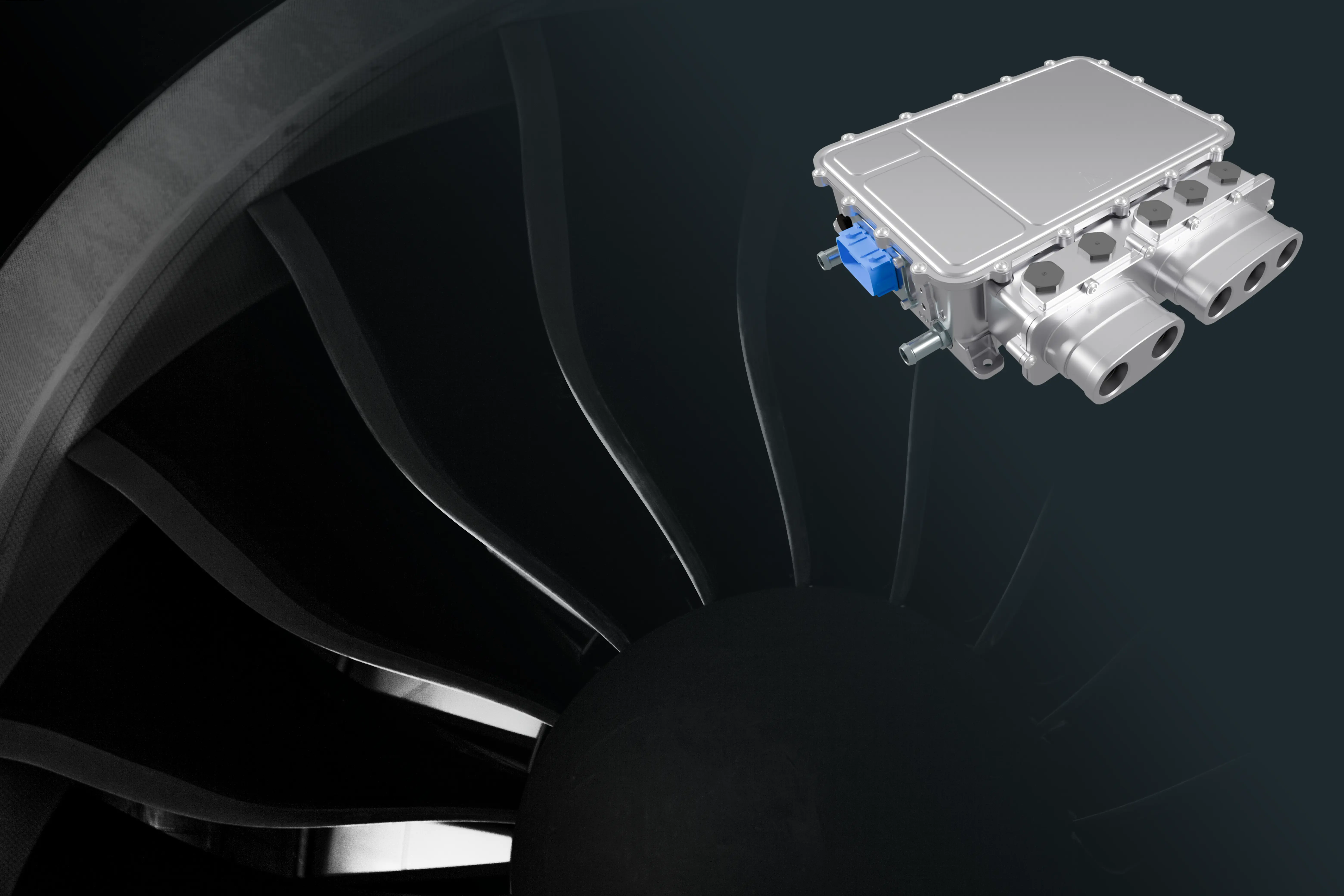
Electrification demands better power electronics
Aerospace electrification is moving fast. This shift, driven by growing pressure to reduce emissions, improve efficiency, and lower operating costs, explains why the industry is actively exploring more hybrid and fully electric aircraft architectures. From regional aircraft with experimental hybrid propulsion systems and the explosion of new eVTOL solutions into the market , electrical power is progressively central to how aircraft are designed and operated.
At Motion Applied, our work in aerospace electrification is inspired by this reality. Through the AMPEX family of silicon carbide inverters, we focus on delivering production ready power electronics that operate at the heart of complex propulsion systems. This system‑first approach underpins our collaborations with both Horizon and Odys, where inverter technology is a central enabler for their flight architectures.
Inverters as the backbone
In hybrid electric aircraft, the inverter sits at a critical point between energy generation, storage, and propulsion. It must coordinate power flowing from the turbines, generators, batteries, and motors while maintaining precise control under rapidly changing operating conditions.
The AMPEX range of MCUs exists to meet exactly these demands. With a common high-performance Silicon Carbide platform at their core, the MCU product family provides a stable foundation for propulsion architectures where reliability and ease of integration matter as much as efficiency. Motion Applied’s approach: the inverter is not simply a power converter, but a control layer within a larger hybrid system.
Supporting Horizon Aircraft’s vertical lift hybrid architecture
In the case of our partner Horizon, Motion Applied is supplying a bespoke motor drive inverter derived from the AMPEX platform for the Cavorite X7’s vertical lift system. This application places particularly demanding constraints on power density, mass, and reliability, with the inverter required to support sustained lift while remaining compact and air‑cooled.
Rather than adapting an automotive‑style solution, the inverter architecture has been developed specifically to support Horizon’s hybrid electric design philosophy. Defined cooling boundaries, predictable thermal behaviour, and a tightly integrated control stack allow the inverter to operate as part of a coherent vertical‑lift system, rather than as an isolated electrical component. This approach reduces integration risk as Horizon progresses through testing and certification.
AMPEX at the heart of Odys Aviation’s hybrid propulsion system
Motion Applied’s collaboration with Odys Aviation takes a similarly integrated approach, but within a different hybrid architecture. As outlined in our case study, the AMPEX MCU‑600 sits at the core of Odys’ high‑speed motor‑generator platforms, creating the inverter stage within a turbine, generator, inverter propulsion chain.
Here, the challenge is system coordination. The inverter must support precise closed‑loop control between the turbine, generator, and electric machine, while enabling fault isolation, graceful degradation, and continued operation under single‑path failures. By building the architecture around a production‑proven inverter platform, both teams reduce integration uncertainty and preserve performance headroom as Odys advances toward initial aircraft deliveries.
Production proven inverter platforms. Crucial in aerospace.
Across both programmes, a common theme is clear: aerospace electrification demands inverter platforms that are mature, well‑defined, and adaptable. Experimental performance alone is not enough. Mechanical packaging, thermal interfaces, software structure, and certification pathways all influence whether a system can progress beyond concept.
The AMPEX MCU platform was designed with these constraints in mind. Defined interfaces and predictable behaviour simplify aircraft integration, reduce unwanted issues during validation, and allow partners to develop their own control strategies on a stable hardware base where required. This setup is essential when multiple organisations are jointly developing flight systems.
Motion Applied is demonstrating how inverter platforms can anchor hybrid‑electric propulsion systems that are engineered for deployment, not just demonstration. In that context, inverter technology is not just enabling electrification… it is shaping the pace and credibility of its adoption across aerospace.